Tolu Oyawole

Design & Engineering

Currently Based

🇬🇧 United Kingdom /

10:08:08

Previously @

AirDev, Zeroqode

Schedule a call

Tolu Oyawole

Design & Engineering

Currently Based

🇬🇧 United Kingdom /

10:08:08

Previously @

AirDev, Zeroqode

Schedule a call

Shortcut

Shortcut

Designed an end-to-end landscaping management system connecting admins, technicians, and homeowners through a single seamless workflow

Designed an end-to-end landscaping management system connecting admins, technicians, and homeowners through a single seamless workflow

Shortcut helps service businesses turn leads into payments in one system. Quoting, scheduling, and invoicing all happen in a single flow, so businesses get paid faster with less manual effort.

Shortcut helps service businesses turn leads into payments in one system. Quoting, scheduling, and invoicing all happen in a single flow, so businesses get paid faster with less manual effort.

Designer

Me

Role

Lead Product Designer

Platform

Web Saas | B2B Fintech

Team

1 PM, 2 Eng, 1 QA

Problem

Problem

Market Context

According to researchandmarkets.com The United States Landscaping Market size is estimated at USD 182.76 billion in 2024, and is expected to reach USD 221.19 billion by 2029, growing at a CAGR of 3.89% during the forecast period (2024-2029).The landscaping industry suffers from operational inefficiency.

Our initial research with 40 landscaping companies revealed:
- 83% used paper-based or spreadsheet systems for scheduling and invoicing
- Average time to create and send a quote: 4.2 hours (including phone calls, emails, and manual calculations)
- Client communication gap: Customers waited an average of 2.8 days for quote responses
- Payment collection took 45-60 days on average, creating significant cash flow problems
- Route planning consumed 45 minutes daily for crews of 3+ teams

Reframed Challenge

How might we create a unified platform that reduces operational overhead for landscaping companies while simultaneously improving the client experience, ultimately driving faster conversion and payment cycles?

How might we create a unified platform that reduces operational overhead for landscaping companies while simultaneously improving the client experience, ultimately driving faster conversion and payment cycles?

Solution

I designed a unified landscaping management platform that helps service providers manage leads, daily operations, and payments in one place, while giving homeowners a simple, transparent way to request services, review quotes, and pay online.

I designed a unified landscaping management platform that helps service providers manage leads, daily operations, and payments in one place, while giving homeowners a simple, transparent way to request services, review quotes, and pay online.

Process

Process

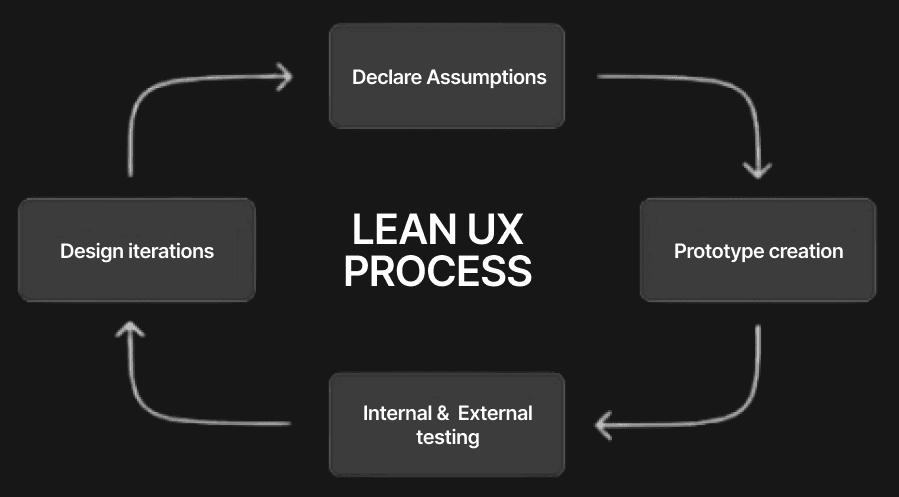
I used Lean UX as the primary framework, supported by Outcome-Driven Design.

I used Lean UX as the primary framework, supported by Outcome-Driven Design.

Why Lean UX?

This was a high-risk MVP

- Scope was large, time was constrained
- Assumptions needed validation quickly
- Iteration was expected post-launch
- Instead of designing features, we designed hypotheses and validated them through workflows and metrics.
Key Challenges

Key Challenges

CHALLENGE 01

Extreme Scope Without Losing Focus

Extreme Scope Without Losing Focus

The platform covered CRM, scheduling, routing, invoicing, and compliance.

Approach

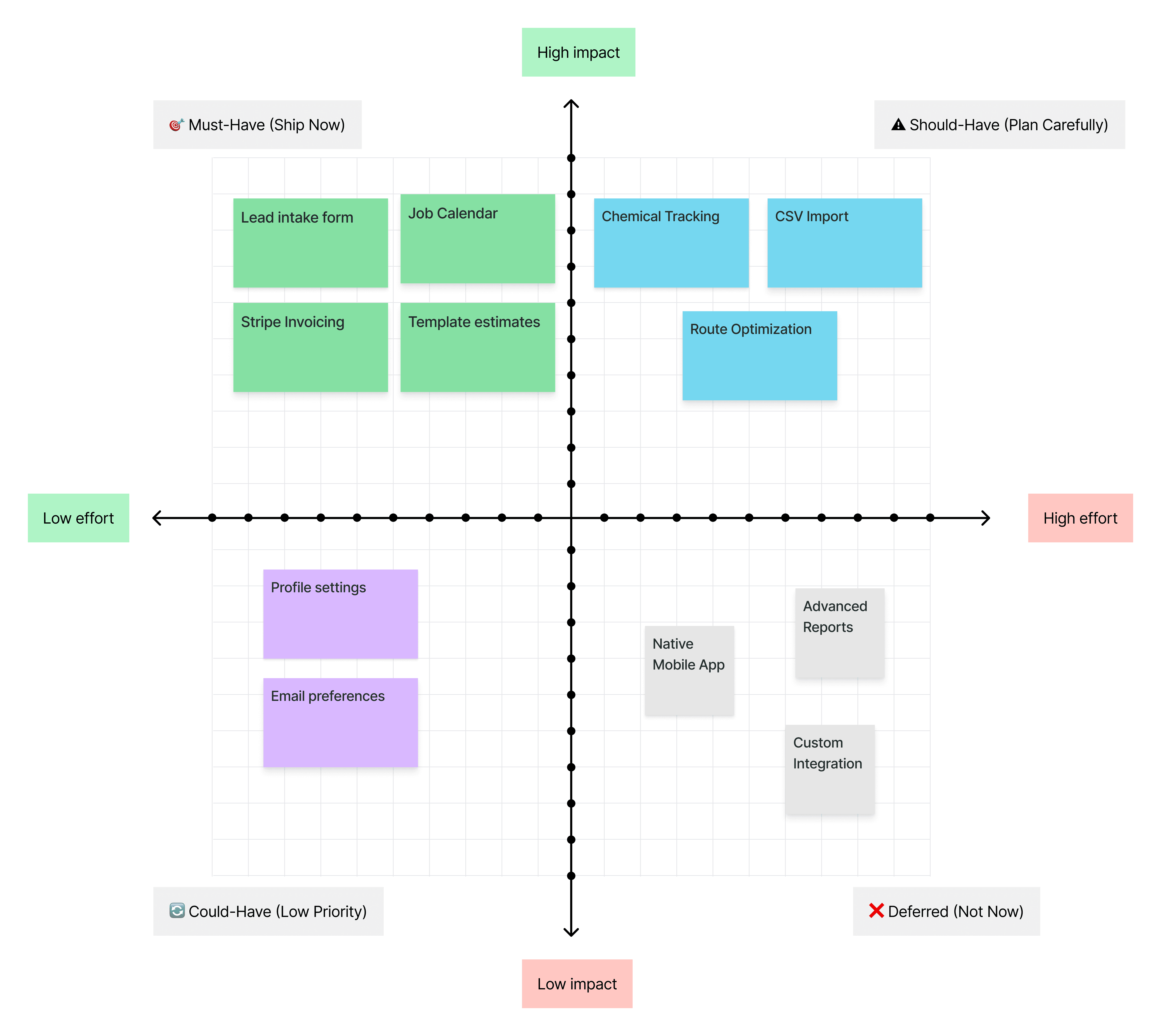
  • Ruthless MVP prioritization

  • Focused on core user journeys, not edge cases

  • Deferred non-critical configurability

  • Used templates and defaults to reduce setup friction

Outcome

  • Ruthless MVP prioritization

  • Focused on core user journeys, not edge cases

  • Deferred non-critical configurability

  • Used templates and defaults to reduce setup friction

The platform covered CRM, scheduling, routing, invoicing, and compliance.

Approach

  • Ruthless MVP prioritization

  • Focused on core user journeys, not edge cases

  • Deferred non-critical configurability

  • Used templates and defaults to reduce setup friction

Outcome

  • Achieved end-to-end workflow coverage without bloating the MVP

CHALLENGE 02

Balancing Flexibility vs Standardization

Balancing Flexibility vs Standardization

Every landscaping company operates differently.

Approach

  • Standardized workflows

  • Allowed flexibility only where it affected revenue or operations

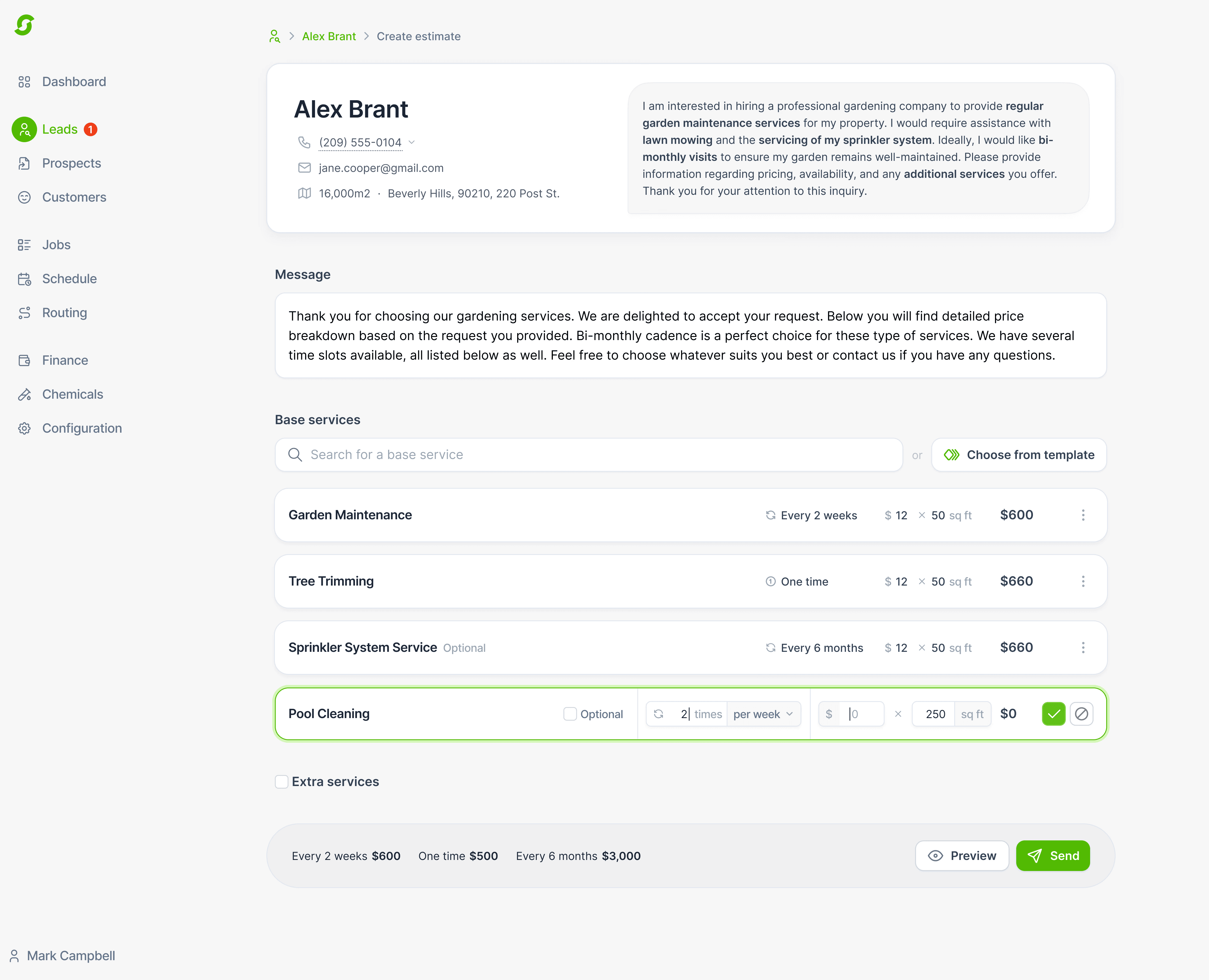
  • Used inline editing (autobinding) to reduce friction

Outcome

  • Faster onboarding

  • Lower cognitive load

  • Fewer support issues

CHALLENGE 03

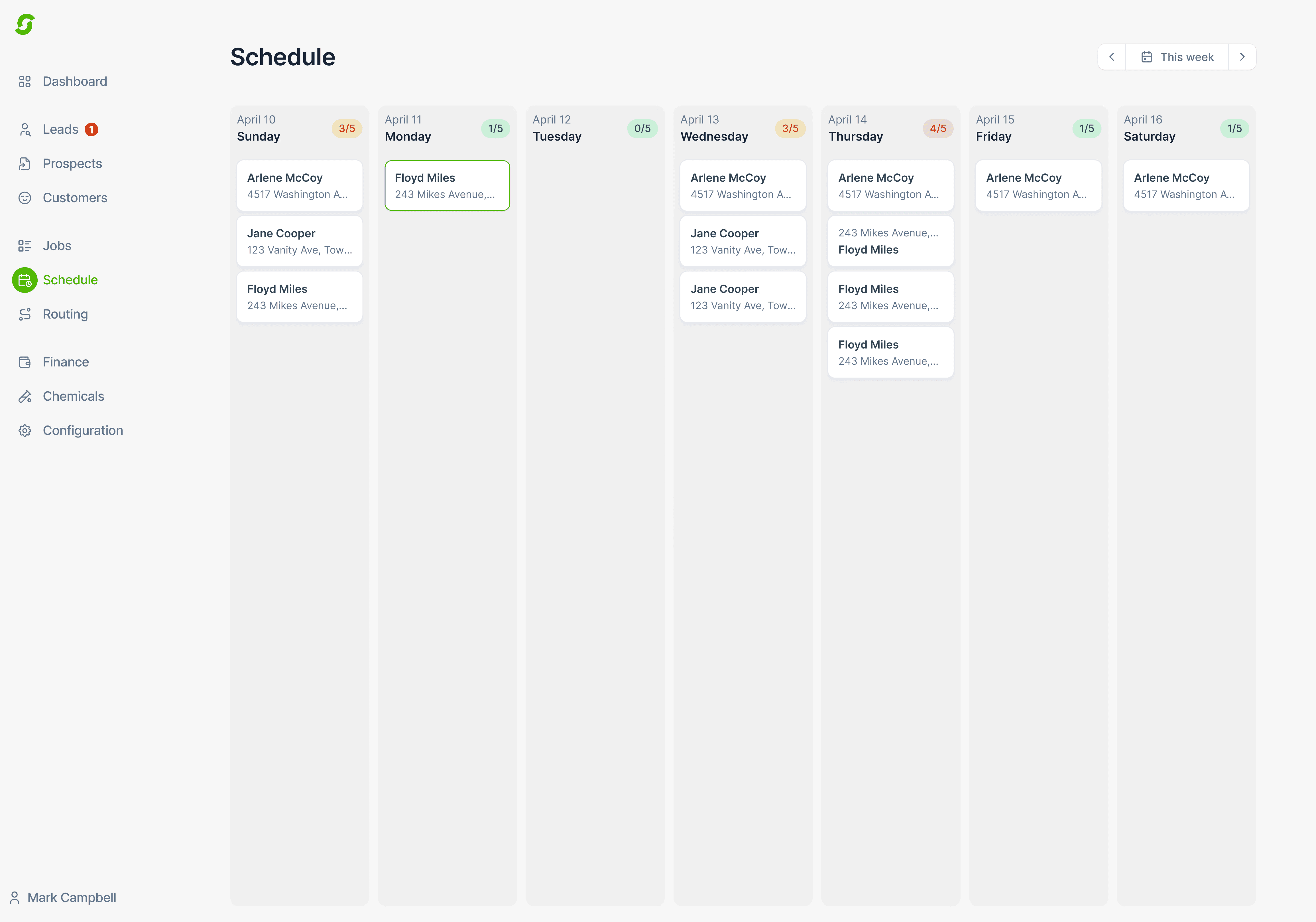
Capacity Planning & Routing Complexity

Cards as living objects

Routing introduces algorithmic complexity and high user expectations.

Approach

  • Abstracted complexity behind simple actions

  • Visual capacity indicators (green/yellow/red)

  • Used Graphhopper for route optimization

  • Allowed manual overrides for trust and control

Outcome

  • Users felt empowered, not constrained

  • High confidence in system recommendations
Key Decisions

Key Decisions

1. One Platform, Multiple Roles

Instead of building separate tools, we designed a role-based system, This mirrors how financial platforms separate operators, payers, and administrators

2. Web-First (Not Native Mobile)

Faster iteration for MVP validation and this aligned with Lean UX principles and reduced time-to-market risk.

3. Payments as a System, Not a Screen

Stripe was embedded at natural workflow breakpoints, This reduced cognitive load and mimicked best-in-class fintech experiences, and this reduced cognitive load and mimicked best-in-class fintech experiences.

Outcomes & Impact

Outcomes & Impact

45%

45%

Less Admin Work


Automated lead intake, scheduling, proposals, and invoicing reduced manual operational effort.

60%

60%

Fewer Scheduling Conflicts


Centralized scheduling and route planning replaced fragmented calendars and manual coordination.

35%

35%

Higher Technician Productivity


Clear daily routes, job details, and real-time updates improved field execution.

50%

50%

Fewer Late Payments


Automated invoices, reminders, and a client payment portal improved cash flow reliability.

Lessons

Lessons

Role-Based Experiences

Every friction point is a conversion problem. By treating each transition (lead→prospect→customer→payment) as a design challenge, we achieved 137% improvement in overall conversion.

Conversion-Focused Design

Don't force one interface to serve all users. Company admins needed density and power, employees needed simplicity, clients needed zero learning curve. This separation drove 89-94% adoption across all user types.

FULL CASE STUDY ON REQUEST

FULL CASE STUDY ON REQUEST

FULL CASE STUDY ON REQUEST

Smooth Scroll
This will hide itself!