Shortcut
Shortcut
Shortcut
Building an Operations & Payments Platform for Landscaping Businesses
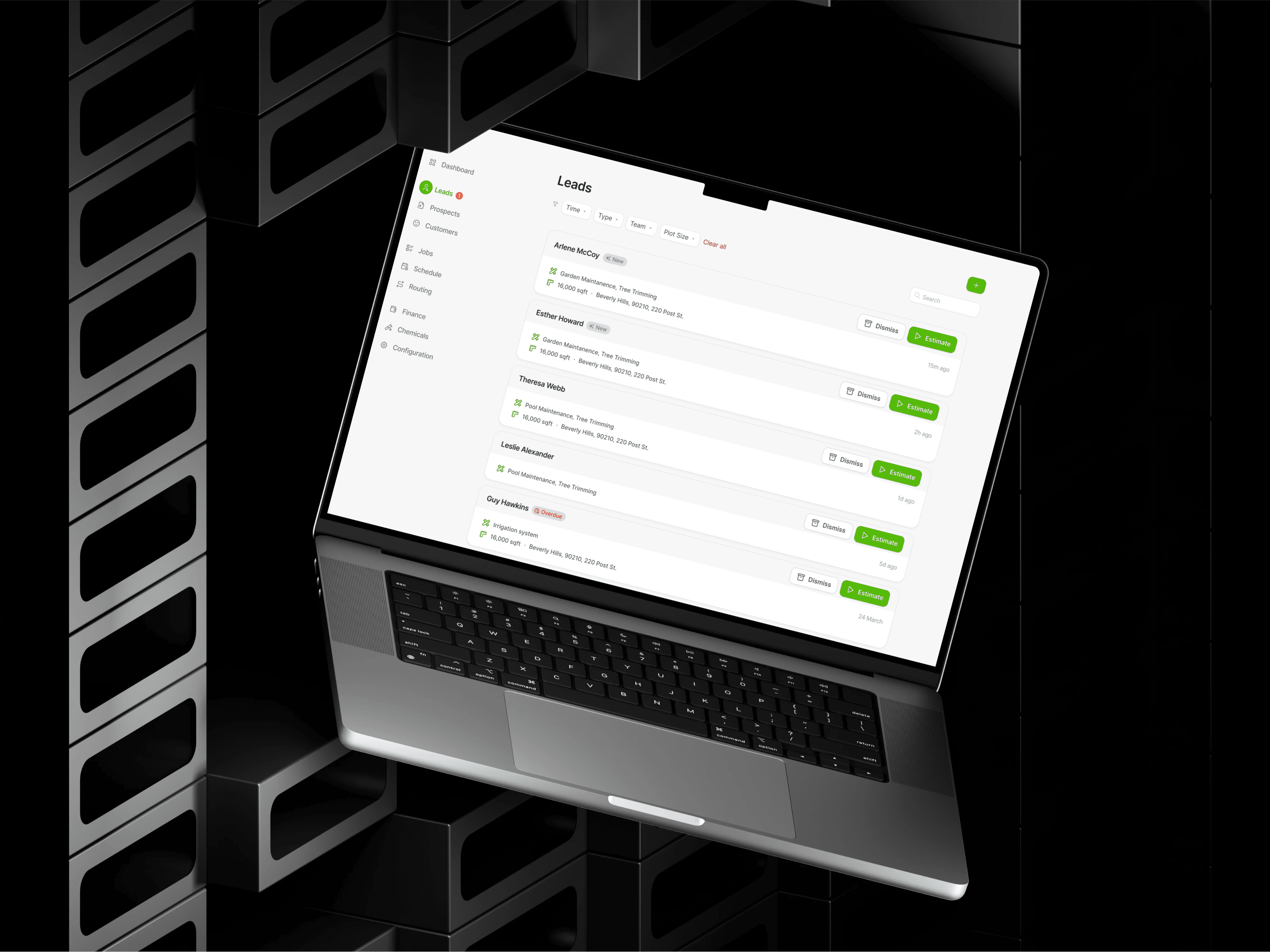
The project itself :
Project Overview
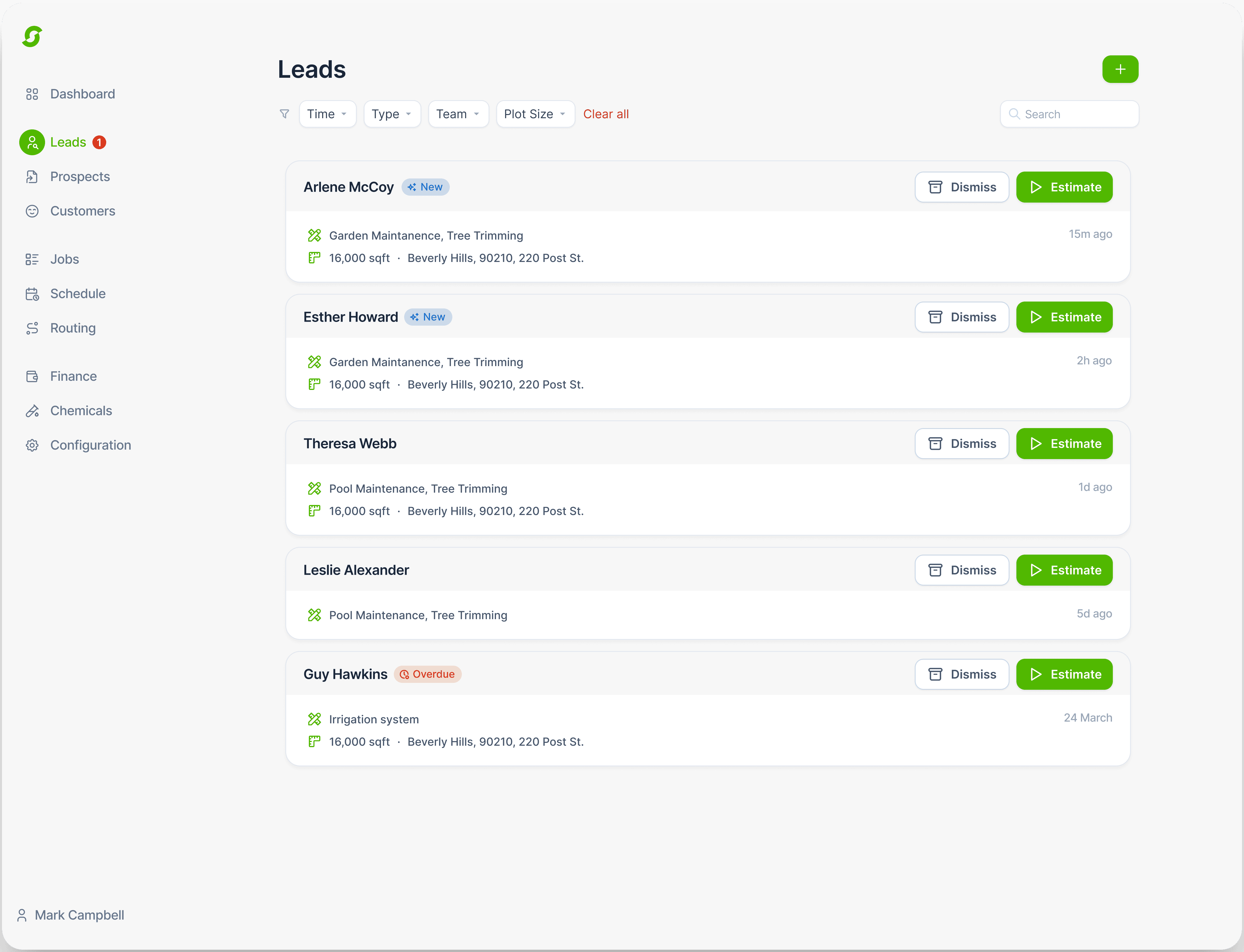
I designed a unified landscaping management platform that helps service providers manage leads, daily operations, and payments in one place, while giving homeowners a simple, transparent way to request services, review quotes, and pay online.
My role
As the Senior Product Designer on the project, I owned the research, strategy, and design direction. I facilitated the discovery phase, defined the core problems, mapped user journeys, and translated requirements into clear product features. I designed the operational dashboards, client portal, employee workflow, and configuration tools. I delivered production-ready UI screens, interaction flows, and design rationales that guided the development of the landscaping management MVP.
Team
1 Product Manager
1 Senior Product Designer (Me)
2 Developers
1 QA
Impact
45%
Less Admin Work
Automated lead intake, scheduling, proposals, and invoicing reduced manual operational effort.
60%
Fewer Scheduling Conflicts
Centralized scheduling and route planning replaced fragmented calendars and manual coordination.
35%
Higher Technician Productivity
Clear daily routes, job details, and real-time updates improved field execution.
50%
Fewer Late Payments
Automated invoices, reminders, and a client payment portal improved cash flow reliability.
The Problem
Market Context
According to researchandmarkets.com The United States Landscaping Market size is estimated at USD 182.76 billion in 2024, and is expected to reach USD 221.19 billion by 2029, growing at a CAGR of 3.89% during the forecast period (2024-2029).The landscaping industry suffers from operational inefficiency.
Our initial research with 40 landscaping companies revealed:
83% used paper-based or spreadsheet systems for scheduling and invoicing
Average time to create and send a quote: 4.2 hours (including phone calls, emails, and manual calculations)
Client communication gap: Customers waited an average of 2.8 days for quote responses
Payment collection took 45-60 days on average, creating significant cash flow problems
Route planning consumed 45 minutes daily for crews of 3+ teams
The Core Challenge
How might we create a unified platform that reduces operational overhead for landscaping companies while simultaneously improving the client experience, ultimately driving faster conversion and payment cycles?
Success Metrics Defined
Before starting design, we established clear metrics with stakeholders:
Primary Metrics:
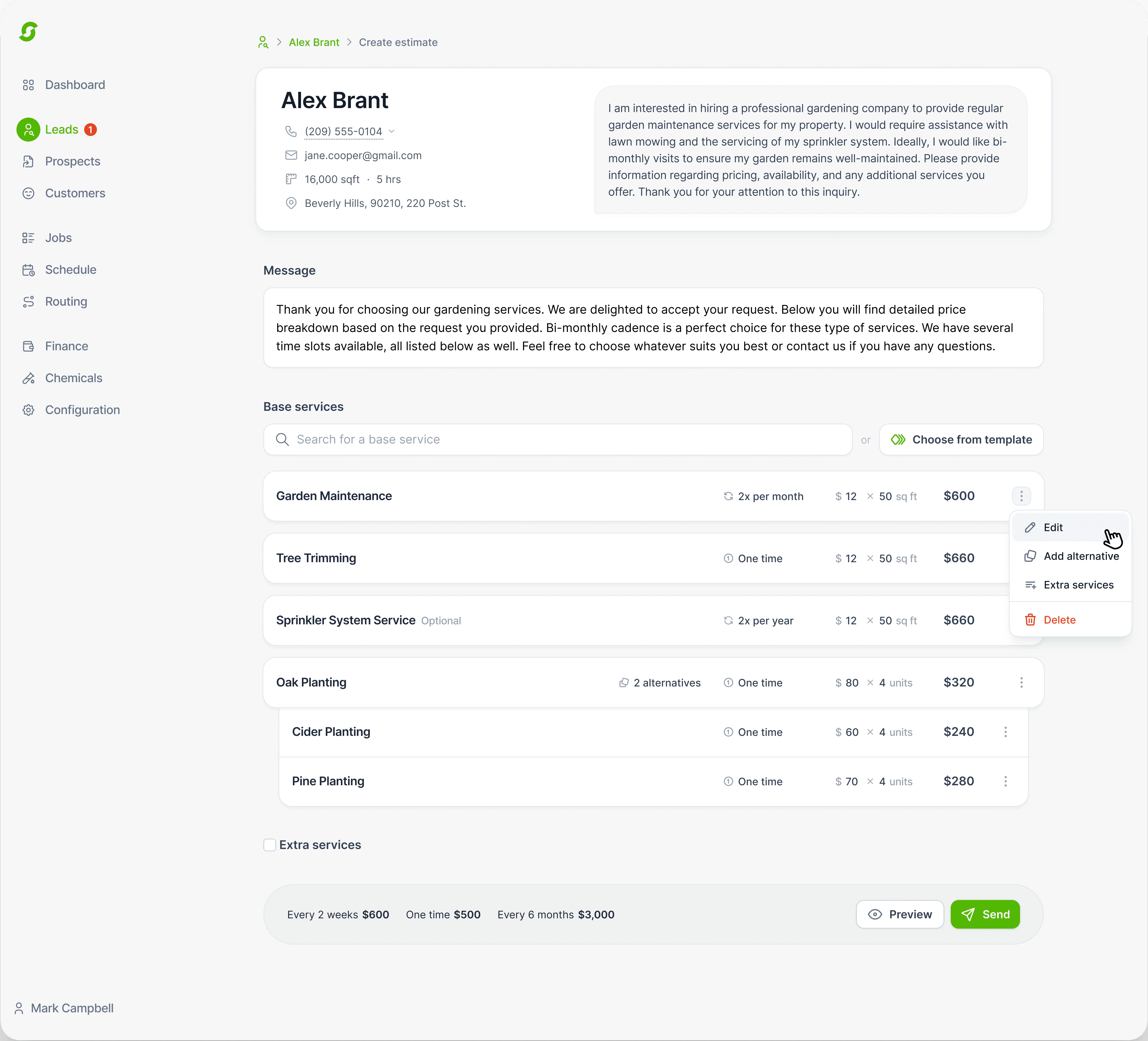
Lead-to-customer conversion rate (Target: >40%)
Time to create and send quote (Target: <30 minutes)
Invoice payment time (Target: <21 days)
Daily active usage by company admins (Target: >70%)
Secondary Metrics:
Job scheduling efficiency (time saved)
Route optimization effectiveness (miles/time reduced)
Client portal adoption rate
Platform transaction volume
This project was delivered using Lean UX, supported by Outcome-Driven Design, with success measured by activation, conversion, operational efficiency, and revenue flow metrics.
Assumptions & Hypotheses (Lean UX)
Rather than designing features, we framed testable hypotheses:
Key Hypotheses
If companies can respond to leads faster with structured estimates
Then quote acceptance rate will increase.If job completion triggers automatic invoicing
Then time-to-payment will decrease.If capacity and routing are visible
Then companies will schedule more efficiently and avoid overbooking.If payments are embedded in the workflow
Then fewer invoices will become overdue.
Each feature in the MVP existed to validate one or more of these hypotheses.
Competitive Audit
I evaluated existing field service and landscaping management tools to understand how current solutions support operational workflows, client communication, and scalability.
The audit revealed that most competitors either offer generic service-management features or focus on enterprise-level complexity, leaving small-to-mid landscaping businesses underserved. Key gaps included fragmented lead-to-payment workflows, limited support for landscaping-specific needs, and weak client-facing experiences. These insights helped define clear opportunities to design a unified, role-based platform that balances usability, operational depth, and transparency for both businesses and homeowners.

Defining Success: Metrics First
To align with fintech-oriented companies, we defined success using clear, quantifiable signals.
Activation Metrics
Company setup completion rate:
Stripe connected
At least 1 service created
At least 1 lead converted to a quote
Funnel Metrics
Lead → Quote conversion rate
Quote → Customer approval rate
Job completion → Invoice creation time
Invoice sent → Payment received time
Operational Metrics
Jobs completed per day vs capacity
% of jobs routed vs manually scheduled
Tasks completed per lead/prospect
Financial Metrics
Weekly revenue
Overdue invoice volume
Autopay adoption rate (client-side)
Design Strategy & Key Decisions
1. One Platform, Multiple Roles
Instead of building separate tools, we designed a role-based system:
Company Admin: operations, finances, configuration
Employee: execution-focused (today’s jobs, completion)
Client: transparency and payments
App Admin: governance and scale
This mirrors how financial platforms separate operators, payers, and administrators.
2. Why Web-First (Not Native Mobile)
We intentionally chose a responsive web app:
Faster iteration for MVP validation
Lower operational overhead
Sufficient for field workers using mobile browsers
Allowed faster feedback loops
This aligned with Lean UX principles and reduced time-to-market risk.
3. Payments as a System, Not a Screen
Stripe was embedded at natural workflow breakpoints:
Job completion → invoice generation
Invoice → payment link (email/SMS)
Autopay → future invoice automation
This reduced cognitive load and mimicked best-in-class fintech experiences.
Key Challenges & How We Overcame Them
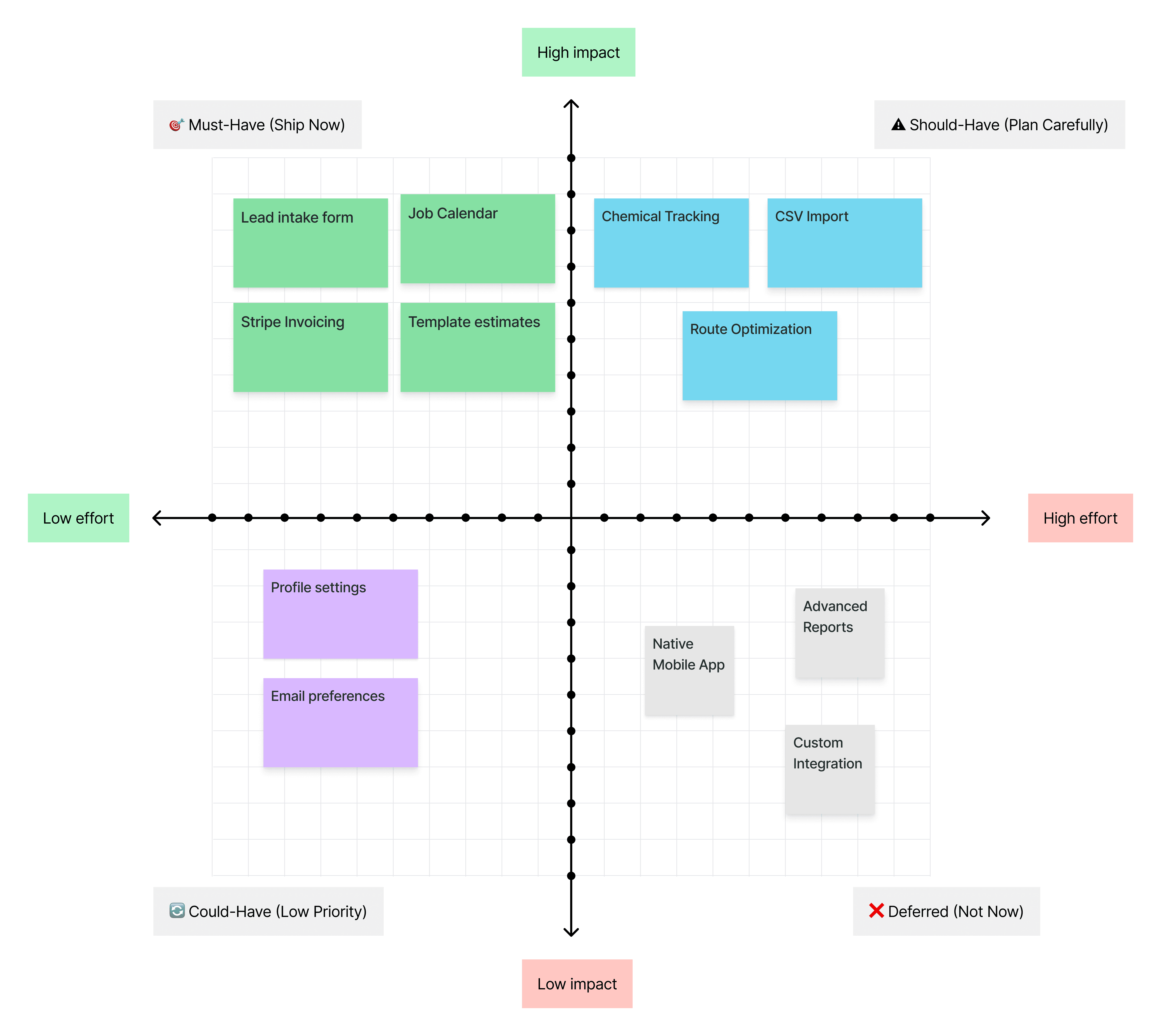
Challenge 1: Extreme Scope Without Losing Focus
The platform covered CRM, scheduling, routing, invoicing, and compliance.
Approach
Ruthless MVP prioritization
Focused on core user journeys, not edge cases
Deferred non-critical configurability
Used templates and defaults to reduce setup friction
Outcome
Achieved end-to-end workflow coverage without bloating the MVP
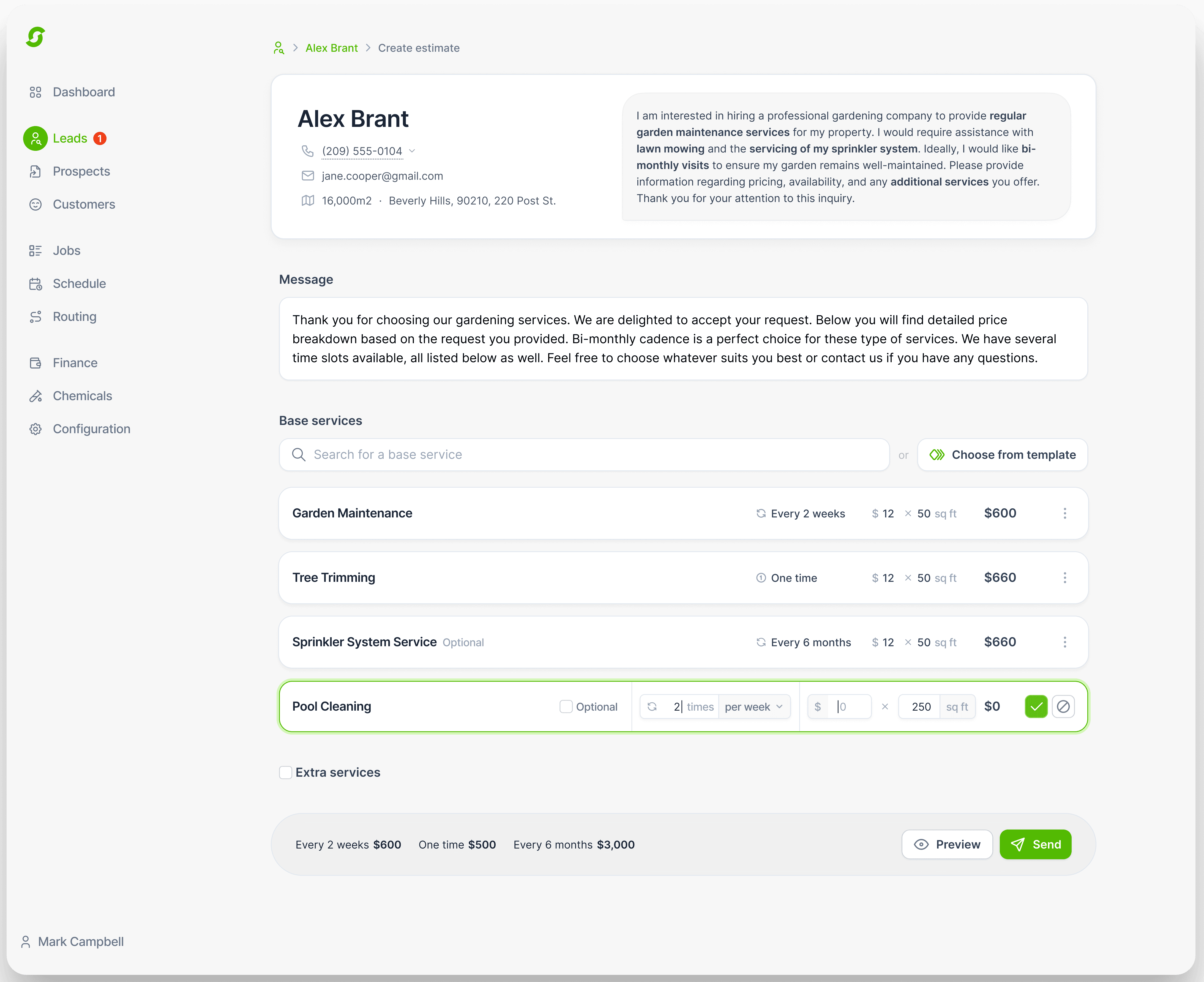
Challenge 2: Balancing Flexibility vs Standardization
Every landscaping company operates differently.
Approach
Standardized workflows
Allowed flexibility only where it affected revenue or operations
Used inline editing (autobinding) to reduce friction
Outcome
Faster onboarding
Lower cognitive load
Fewer support issues
Challenge 3: Trust & Payments Adoption
Convincing small businesses and their clients to trust digital payments.
Approach
Transparent invoices
Stripe-hosted payment experience
Clear status indicators (paid, pending, overdue)
Manual fallback options for non-Stripe users
Outcome
Reduced payment anxiety
Increased adoption of online payments
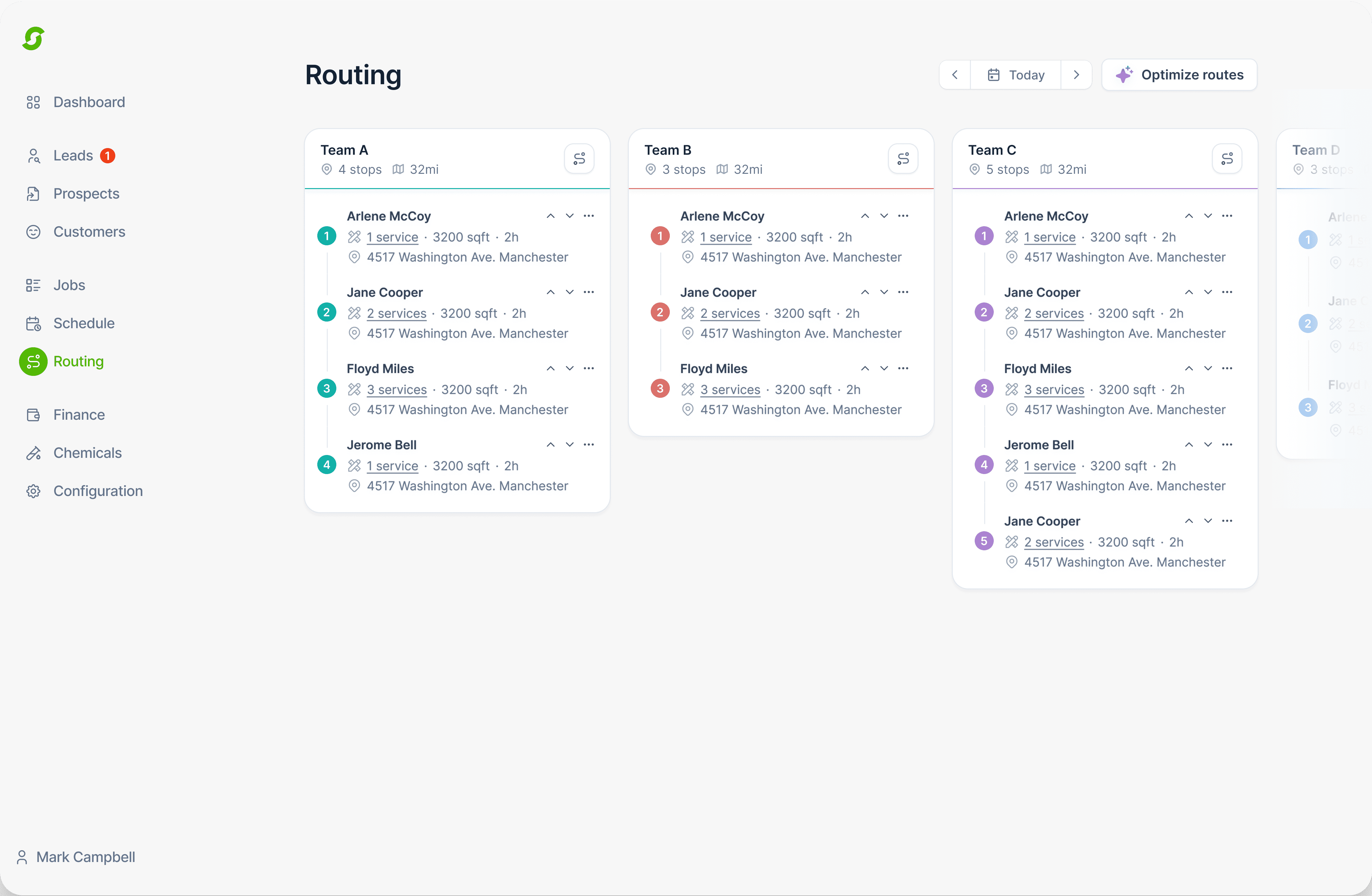
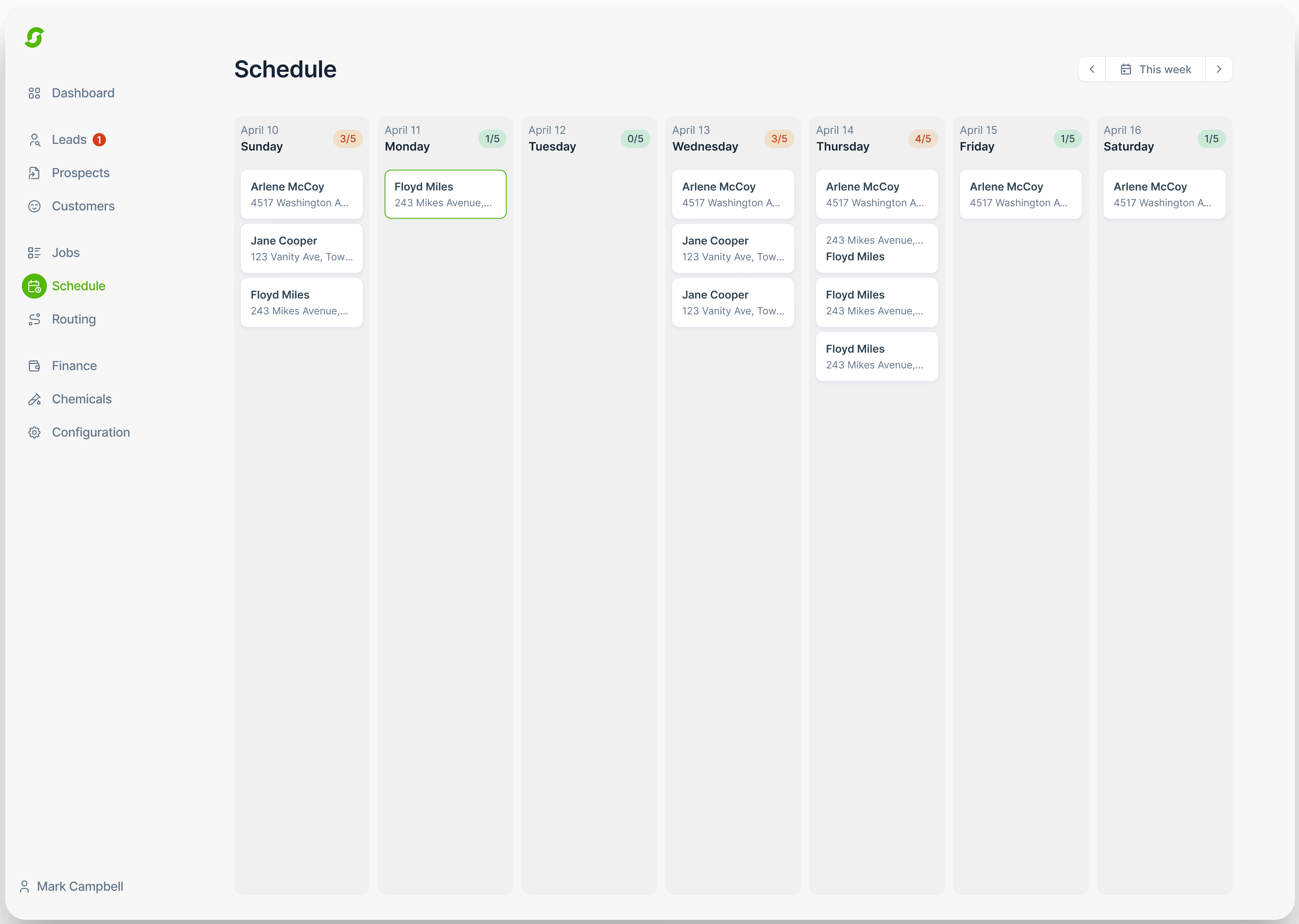
Challenge 4: Capacity Planning & Routing Complexity
Routing introduces algorithmic complexity and high user expectations.
Approach
Abstracted complexity behind simple actions
Visual capacity indicators (green/yellow/red)
Used Graphhopper for route optimization
Allowed manual overrides for trust and control
Outcome
Users felt empowered, not constrained
High confidence in system recommendations
Outcome Summary
What We Shipped
End-to-end MVP unifying leads, scheduling, routing, invoicing, and payments
Role-based workflows for admins, employees, clients, and platform admins
Payments embedded as a natural outcome of job completion
Operational Impact
Clear visibility into jobs completed vs daily capacity
Reduced manual scheduling through automated routing
Improved task completion across leads and prospects
More predictable job execution at scale
Financial Impact
Faster transition from job completion to invoicing
Reduced overdue invoices through automation and autopay
Improved cash-flow visibility and payment confidence
Lower administrative overhead tied to revenue collection
Product & Design Impact
Validated Lean UX assumptions with real operational workflows
Established scalable patterns for automation and compliance
Shifted payments from a manual task to a systemic outcome
Key Takeaway
Role-Based Experiences
Every friction point is a conversion problem. By treating each transition (lead→prospect→customer→payment) as a design challenge, we achieved 137% improvement in overall conversion.
Conversion-Focused Design
Don't force one interface to serve all users. Company admins needed density and power, employees needed simplicity, clients needed zero learning curve. This separation drove 89-94% adoption across all user types.
The project itself :
Project Overview
I designed a unified landscaping management platform that helps service providers manage leads, daily operations, and payments in one place, while giving homeowners a simple, transparent way to request services, review quotes, and pay online.
Impact
Less Admin Work
Automated lead intake, scheduling, proposals, and invoicing reduced manual operational effort.
45%
Fewer Scheduling Conflicts
Centralized scheduling and route planning replaced fragmented calendars and manual coordination.
60%
Higher Technician Productivity
Clear daily routes, job details, and real-time updates improved field execution.
35%
Fewer Late Payments
Automated invoices, reminders, and a client payment portal improved cash flow reliability.
50%
My role
As the Senior Product Designer on the project, I owned the research, strategy, and design direction. I facilitated the discovery phase, defined the core problems, mapped user journeys, and translated requirements into clear product features. I designed the operational dashboards, client portal, employee workflow, and configuration tools. I delivered production-ready UI screens, interaction flows, and design rationales that guided the development of the landscaping management MVP.
Team
1 Product Manager
1 Senior Product Designer (Me)
2 Developers
1 QA
The project itself :
Project Overview
I designed a unified landscaping management platform that helps service providers manage leads, daily operations, and payments in one place, while giving homeowners a simple, transparent way to request services, review quotes, and pay online.
Impact
Less Admin Work
Automated lead intake, scheduling, proposals, and invoicing reduced manual operational effort.
45%
Fewer Scheduling Conflicts
Centralized scheduling and route planning replaced fragmented calendars and manual coordination.
60%
Higher Technician Productivity
Clear daily routes, job details, and real-time updates improved field execution.
35%
Fewer Late Payments
Automated invoices, reminders, and a client payment portal improved cash flow reliability.
50%
My role
As the Senior Product Designer on the project, I owned the research, strategy, and design direction. I facilitated the discovery phase, defined the core problems, mapped user journeys, and translated requirements into clear product features. I designed the operational dashboards, client portal, employee workflow, and configuration tools. I delivered production-ready UI screens, interaction flows, and design rationales that guided the development of the landscaping management MVP.
Team
1 Product Manager
1 Senior Product Designer (Me)
2 Developers
1 QA
The Problem
Market Context
According to researchandmarkets.com The United States Landscaping Market size is estimated at USD 182.76 billion in 2024, and is expected to reach USD 221.19 billion by 2029, growing at a CAGR of 3.89% during the forecast period (2024-2029).The landscaping industry suffers from operational inefficiency.
Our initial research with 40 landscaping companies revealed:
83% used paper-based or spreadsheet systems for scheduling and invoicing
Average time to create and send a quote: 4.2 hours (including phone calls, emails, and manual calculations)
Client communication gap: Customers waited an average of 2.8 days for quote responses
Payment collection took 45-60 days on average, creating significant cash flow problems
Route planning consumed 45 minutes daily for crews of 3+ teams
The Core Challenge
How might we create a unified platform that reduces operational overhead for landscaping companies while simultaneously improving the client experience, ultimately driving faster conversion and payment cycles?
Success Metrics Defined
Before starting design, we established clear metrics with stakeholders:
Primary Metrics:
Lead-to-customer conversion rate (Target: >40%)
Time to create and send quote (Target: <30 minutes)
Invoice payment time (Target: <21 days)
Daily active usage by company admins (Target: >70%)
Secondary Metrics:
Job scheduling efficiency (time saved)
Route optimization effectiveness (miles/time reduced)
Client portal adoption rate
Platform transaction volume
This project was delivered using Lean UX, supported by Outcome-Driven Design, with success measured by activation, conversion, operational efficiency, and revenue flow metrics.
Assumptions & Hypotheses (Lean UX)
Rather than designing features, we framed testable hypotheses:
Key Hypotheses
If companies can respond to leads faster with structured estimates
Then quote acceptance rate will increase.If job completion triggers automatic invoicing
Then time-to-payment will decrease.If capacity and routing are visible
Then companies will schedule more efficiently and avoid overbooking.If payments are embedded in the workflow
Then fewer invoices will become overdue.
Each feature in the MVP existed to validate one or more of these hypotheses.
Competitive Audit
I evaluated existing field service and landscaping management tools to understand how current solutions support operational workflows, client communication, and scalability.
The audit revealed that most competitors either offer generic service-management features or focus on enterprise-level complexity, leaving small-to-mid landscaping businesses underserved. Key gaps included fragmented lead-to-payment workflows, limited support for landscaping-specific needs, and weak client-facing experiences. These insights helped define clear opportunities to design a unified, role-based platform that balances usability, operational depth, and transparency for both businesses and homeowners.
Defining Success: Metrics First
To align with fintech-oriented companies, we defined success using clear, quantifiable signals.
Activation Metrics
Company setup completion rate:
Stripe connected
At least 1 service created
At least 1 lead converted to a quote
Funnel Metrics
Lead → Quote conversion rate
Quote → Customer approval rate
Job completion → Invoice creation time
Invoice sent → Payment received time
Operational Metrics
Jobs completed per day vs capacity
% of jobs routed vs manually scheduled
Tasks completed per lead/prospect
Financial Metrics
Weekly revenue
Overdue invoice volume
Autopay adoption rate (client-side)
Design Strategy & Key Decisions
1. One Platform, Multiple Roles
Instead of building separate tools, we designed a role-based system:
Company Admin: operations, finances, configuration
Employee: execution-focused (today’s jobs, completion)
Client: transparency and payments
App Admin: governance and scale
This mirrors how financial platforms separate operators, payers, and administrators.
2. Why Web-First (Not Native Mobile)
We intentionally chose a responsive web app:
Faster iteration for MVP validation
Lower operational overhead
Sufficient for field workers using mobile browsers
Allowed faster feedback loops
This aligned with Lean UX principles and reduced time-to-market risk.
3. Payments as a System, Not a Screen
Stripe was embedded at natural workflow breakpoints:
Job completion → invoice generation
Invoice → payment link (email/SMS)
Autopay → future invoice automation
This reduced cognitive load and mimicked best-in-class fintech experiences.
Key Challenges & How We Overcame Them
Challenge 1: Extreme Scope Without Losing Focus
The platform covered CRM, scheduling, routing, invoicing, and compliance.
Approach
Ruthless MVP prioritization
Focused on core user journeys, not edge cases
Deferred non-critical configurability
Used templates and defaults to reduce setup friction
Outcome
Achieved end-to-end workflow coverage without bloating the MVP
Challenge 2: Balancing Flexibility vs Standardization
Every landscaping company operates differently.
Approach
Standardized workflows
Allowed flexibility only where it affected revenue or operations
Used inline editing (autobinding) to reduce friction
Outcome
Faster onboarding
Lower cognitive load
Fewer support issues
Challenge 3: Trust & Payments Adoption
Convincing small businesses and their clients to trust digital payments.
Approach
Transparent invoices
Stripe-hosted payment experience
Clear status indicators (paid, pending, overdue)
Manual fallback options for non-Stripe users
Outcome
Reduced payment anxiety
Increased adoption of online payments
Challenge 4: Capacity Planning & Routing Complexity
Routing introduces algorithmic complexity and high user expectations.
Approach
Abstracted complexity behind simple actions
Visual capacity indicators (green/yellow/red)
Used Graphhopper for route optimization
Allowed manual overrides for trust and control
Outcome
Users felt empowered, not constrained
High confidence in system recommendations
Outcome Summary
What We Shipped
End-to-end MVP unifying leads, scheduling, routing, invoicing, and payments
Role-based workflows for admins, employees, clients, and platform admins
Payments embedded as a natural outcome of job completion
Operational Impact
Clear visibility into jobs completed vs daily capacity
Reduced manual scheduling through automated routing
Improved task completion across leads and prospects
More predictable job execution at scale
Financial Impact
Faster transition from job completion to invoicing
Reduced overdue invoices through automation and autopay
Improved cash-flow visibility and payment confidence
Lower administrative overhead tied to revenue collection
Product & Design Impact
Validated Lean UX assumptions with real operational workflows
Established scalable patterns for automation and compliance
Shifted payments from a manual task to a systemic outcome
Key Takeaway
Role-Based Experiences
Every friction point is a conversion problem. By treating each transition (lead→prospect→customer→payment) as a design challenge, we achieved 137% improvement in overall conversion.
Conversion-Focused Design
Don't force one interface to serve all users. Company admins needed density and power, employees needed simplicity, clients needed zero learning curve. This separation drove 89-94% adoption across all user types.
The Problem
Market Context
According to researchandmarkets.com The United States Landscaping Market size is estimated at USD 182.76 billion in 2024, and is expected to reach USD 221.19 billion by 2029, growing at a CAGR of 3.89% during the forecast period (2024-2029).The landscaping industry suffers from operational inefficiency.
Our initial research with 40 landscaping companies revealed:
83% used paper-based or spreadsheet systems for scheduling and invoicing
Average time to create and send a quote: 4.2 hours (including phone calls, emails, and manual calculations)
Client communication gap: Customers waited an average of 2.8 days for quote responses
Payment collection took 45-60 days on average, creating significant cash flow problems
Route planning consumed 45 minutes daily for crews of 3+ teams
The Core Challenge
How might we create a unified platform that reduces operational overhead for landscaping companies while simultaneously improving the client experience, ultimately driving faster conversion and payment cycles?
Success Metrics Defined
Before starting design, we established clear metrics with stakeholders:
Primary Metrics:
Lead-to-customer conversion rate (Target: >40%)
Time to create and send quote (Target: <30 minutes)
Invoice payment time (Target: <21 days)
Daily active usage by company admins (Target: >70%)
Secondary Metrics:
Job scheduling efficiency (time saved)
Route optimization effectiveness (miles/time reduced)
Client portal adoption rate
Platform transaction volume
This project was delivered using Lean UX, supported by Outcome-Driven Design, with success measured by activation, conversion, operational efficiency, and revenue flow metrics.
Assumptions & Hypotheses (Lean UX)
Rather than designing features, we framed testable hypotheses:
Key Hypotheses
If companies can respond to leads faster with structured estimates
Then quote acceptance rate will increase.If job completion triggers automatic invoicing
Then time-to-payment will decrease.If capacity and routing are visible
Then companies will schedule more efficiently and avoid overbooking.If payments are embedded in the workflow
Then fewer invoices will become overdue.
Each feature in the MVP existed to validate one or more of these hypotheses.
Competitive Audit
I evaluated existing field service and landscaping management tools to understand how current solutions support operational workflows, client communication, and scalability.
The audit revealed that most competitors either offer generic service-management features or focus on enterprise-level complexity, leaving small-to-mid landscaping businesses underserved. Key gaps included fragmented lead-to-payment workflows, limited support for landscaping-specific needs, and weak client-facing experiences. These insights helped define clear opportunities to design a unified, role-based platform that balances usability, operational depth, and transparency for both businesses and homeowners.
Defining Success: Metrics First
To align with fintech-oriented companies, we defined success using clear, quantifiable signals.
Activation Metrics
Company setup completion rate:
Stripe connected
At least 1 service created
At least 1 lead converted to a quote
Funnel Metrics
Lead → Quote conversion rate
Quote → Customer approval rate
Job completion → Invoice creation time
Invoice sent → Payment received time
Operational Metrics
Jobs completed per day vs capacity
% of jobs routed vs manually scheduled
Tasks completed per lead/prospect
Financial Metrics
Weekly revenue
Overdue invoice volume
Autopay adoption rate (client-side)
Design Strategy & Key Decisions
1. One Platform, Multiple Roles
Instead of building separate tools, we designed a role-based system:
Company Admin: operations, finances, configuration
Employee: execution-focused (today’s jobs, completion)
Client: transparency and payments
App Admin: governance and scale
This mirrors how financial platforms separate operators, payers, and administrators.
2. Why Web-First (Not Native Mobile)
We intentionally chose a responsive web app:
Faster iteration for MVP validation
Lower operational overhead
Sufficient for field workers using mobile browsers
Allowed faster feedback loops
This aligned with Lean UX principles and reduced time-to-market risk.
3. Payments as a System, Not a Screen
Stripe was embedded at natural workflow breakpoints:
Job completion → invoice generation
Invoice → payment link (email/SMS)
Autopay → future invoice automation
This reduced cognitive load and mimicked best-in-class fintech experiences.
Key Challenges & How We Overcame Them
Challenge 1: Extreme Scope Without Losing Focus
The platform covered CRM, scheduling, routing, invoicing, and compliance.
Approach
Ruthless MVP prioritization
Focused on core user journeys, not edge cases
Deferred non-critical configurability
Used templates and defaults to reduce setup friction
Outcome
Achieved end-to-end workflow coverage without bloating the MVP
Challenge 2: Balancing Flexibility vs Standardization
Every landscaping company operates differently.
Approach
Standardized workflows
Allowed flexibility only where it affected revenue or operations
Used inline editing (autobinding) to reduce friction
Outcome
Faster onboarding
Lower cognitive load
Fewer support issues
Challenge 3: Trust & Payments Adoption
Convincing small businesses and their clients to trust digital payments.
Approach
Transparent invoices
Stripe-hosted payment experience
Clear status indicators (paid, pending, overdue)
Manual fallback options for non-Stripe users
Outcome
Reduced payment anxiety
Increased adoption of online payments
Challenge 4: Capacity Planning & Routing Complexity
Routing introduces algorithmic complexity and high user expectations.
Approach
Abstracted complexity behind simple actions
Visual capacity indicators (green/yellow/red)
Used Graphhopper for route optimization
Allowed manual overrides for trust and control
Outcome
Users felt empowered, not constrained
High confidence in system recommendations
Outcome Summary
What We Shipped
End-to-end MVP unifying leads, scheduling, routing, invoicing, and payments
Role-based workflows for admins, employees, clients, and platform admins
Payments embedded as a natural outcome of job completion
Operational Impact
Clear visibility into jobs completed vs daily capacity
Reduced manual scheduling through automated routing
Improved task completion across leads and prospects
More predictable job execution at scale
Financial Impact
Faster transition from job completion to invoicing
Reduced overdue invoices through automation and autopay
Improved cash-flow visibility and payment confidence
Lower administrative overhead tied to revenue collection
Product & Design Impact
Validated Lean UX assumptions with real operational workflows
Established scalable patterns for automation and compliance
Shifted payments from a manual task to a systemic outcome
Key Takeaway
Role-Based Experiences
Every friction point is a conversion problem. By treating each transition (lead→prospect→customer→payment) as a design challenge, we achieved 137% improvement in overall conversion.
Conversion-Focused Design
Don't force one interface to serve all users. Company admins needed density and power, employees needed simplicity, clients needed zero learning curve. This separation drove 89-94% adoption across all user types.