Tolu Oyawole

Design & Engineering

Currently Based

🇬🇧 United Kingdom /

02:04:51

Previously @

AirDev, Zeroqode

Schedule a call

Tolu Oyawole

Design & Engineering

Currently Based

🇬🇧 United Kingdom /

02:04:51

Previously @

AirDev, Zeroqode

Schedule a call

Paylo

Paylo

A UK-focused mobile banking super-app built to make intelligent money mangement feel effortlessly.

A UK-focused mobile banking super-app built to make intelligent money mangement feel effortlessly.

Paylo is a mobile-first UK fintech super-app consolidating banking, payments, savings, and AI-powered financial intelligence into a single iOS-native experience.

Paylo is a mobile-first UK fintech super-app consolidating banking, payments, savings, and AI-powered financial intelligence into a single seamless experience.

Paylo is a mobile-first UK fintech super-app consolidating banking, payments, savings, and AI-powered financial intelligence into a single iOS-native experience.

Designer

Me

Role

Product Designer

Platform

B2C | SaaS

Team

1 PM, 2 Eng, 1 QA

Problem

Problem

Context

Paylo was designed for UK adults managing money across multiple disconnected tools. The average user juggles three or more apps to get a complete picture of their finances. Banking in one place, budgeting in another, savings somewhere else. The result is not just inconvenience. It is a genuine loss of financial control. People miss bills, underestimate spending, and save less than they intend to because the cognitive overhead of context-switching between apps erodes the habit entirely.

Reframed Challenge

How do we build a single financial product that reduces the mental load of money management, not just the number of apps on the homescreen.

How do we build a single financial product that reduces the mental load of money management, not just the number of apps on the homescreen.

Solution

Designed a mobile banking super-app that replaces fragmented financial tools with a single iOS-native experience, where AI moves beyond surfacing data to driving action — turning insights into specific, animated, per-category budget changes a user can see, understand, and act on in real time.

Designed a mobile banking super-app that replaces fragmented financial tools where AI moves beyond surfacing data to driving action — turning insights into specific, animated, per-category budget changes a user can see, understand, and act on in real time.

Designed a mobile banking super-app that replaces fragmented financial tools with a single iOS-native experience, where AI moves beyond surfacing data to driving action — turning insights into specific, animated, per-category budget changes a user can see, understand, and act on in real time.

Process

Process

Discovery

User interviews with UK adults across age groups to understand fragmented money management behaviours. Competitive audit of Monzo, Revolut, Starling, and Wise. Jobs-to-be-done mapping to identify the core financial jobs users perform daily versus occasionally.

Problem framing

Synthesised research into four named problem statements: fragmentation anxiety, payment uncertainty, AI that observes but does not act, and invisible premium value. Each one shaped a specific design decision downstream.

Information architecture

Defined the navigation model before designing a single screen. Five primary tabs, a sub-screen system for all drill-down flows, and a separate auth flow. Documented a full screen inventory of 18-plus screens before opening a design file.

Design system

Built a token-based component system from the ground up. Colour, typography, spacing, motion curves, and component variants all defined before screen composition began. Ensured contrast ratios met WCAG 2.1 AA across every surface.

Screen design

Designed each screen against the problem it was solving, not against a template. Home answers three questions without a tap. Payments builds verification into the flow. AI Insights drives action not just awareness. Every decision is articulable.

Prototyping

Built a fully interactive React prototype wiring all flows end-to-end. Not a clickthrough. Every state, animation, edge case, and error condition is live and navigable.

Monetisation design

Mapped premium value across six ambient touchpoints before designing the upgrade screen itself. The Premium screen was the last thing designed, not the first.

Review and iteration

Accessibility audit, colour blindness simulation, touch target verification, and motion review. Caught and resolved specific issues with colour-only state communication before finalising.

Discovery

User interviews with UK adults across age groups to understand fragmented money management behaviours. Competitive audit of Monzo, Revolut, Starling, and Wise. Jobs-to-be-done mapping to identify the core financial jobs users perform daily versus occasionally.

Problem framing

Synthesised research into four named problem statements: fragmentation anxiety, payment uncertainty, AI that observes but does not act, and invisible premium value. Each one shaped a specific design decision downstream.

Information architecture

Defined the navigation model before designing a single screen. Five primary tabs, a sub-screen system for all drill-down flows, and a separate auth flow. Documented a full screen inventory of 18-plus screens before opening a design file.

Design system

Built a token-based component system from the ground up. Colour, typography, spacing, motion curves, and component variants all defined before screen composition began. Ensured contrast ratios met WCAG 2.1 AA across every surface.

Screen design

Designed each screen against the problem it was solving, not against a template. Home answers three questions without a tap. Payments builds verification into the flow. AI Insights drives action not just awareness. Every decision is articulable.

Prototyping

Built a fully interactive React prototype wiring all flows end-to-end. Not a clickthrough. Every state, animation, edge case, and error condition is live and navigable.

Monetisation design

Mapped premium value across six ambient touchpoints before designing the upgrade screen itself. The Premium screen was the last thing designed, not the first.

Review and iteration

Accessibility audit, colour blindness simulation, touch target verification, and motion review. Caught and resolved specific issues with colour-only state communication before finalising.

Discovery

Discovery

User interviews with UK adults across age groups to understand fragmented money management behaviours. Competitive audit of Monzo, Revolut, Starling, and Wise. Jobs-to-be-done mapping to identify the core financial jobs users perform daily versus occasionally.

Problem framing

Problem framing

Synthesised research into four named problem statements: fragmentation anxiety, payment uncertainty, AI that observes but does not act, and invisible premium value. Each one shaped a specific design decision downstream.

Information architecture

Information architecture

Defined the navigation model before designing a single screen. Five primary tabs, a sub-screen system for all drill-down flows, and a separate auth flow. Documented a full screen inventory of 18-plus screens before opening a design file.

Design system

Design system

Built a token-based component system from the ground up. Colour, typography, spacing, motion curves, and component variants all defined before screen composition began. Ensured contrast ratios met WCAG 2.1 AA across every surface.

Screen design

Screen design

Designed each screen against the problem it was solving, not against a template. Home answers three questions without a tap. Payments builds verification into the flow. AI Insights drives action not just awareness. Every decision is articulable.

Prototyping

Prototyping

Built a fully interactive React prototype wiring all flows end-to-end. Not a clickthrough. Every state, animation, edge case, and error condition is live and navigable.

Monetisation design

Monetisation design

Mapped premium value across six ambient touchpoints before designing the upgrade screen itself. The Premium screen was the last thing designed, not the first.

Review and iteration

Review and iteration

Accessibility audit, colour blindness simulation, touch target verification, and motion review. Caught and resolved specific issues with colour-only state communication before finalising.

Discovery

User interviews with UK adults across age groups to understand fragmented money management behaviours. Competitive audit of Monzo, Revolut, Starling, and Wise. Jobs-to-be-done mapping to identify the core financial jobs users perform daily versus occasionally.

Problem framing

Synthesised research into four named problem statements: fragmentation anxiety, payment uncertainty, AI that observes but does not act, and invisible premium value. Each one shaped a specific design decision downstream.

Information architecture

Defined the navigation model before designing a single screen. Five primary tabs, a sub-screen system for all drill-down flows, and a separate auth flow. Documented a full screen inventory of 18-plus screens before opening a design file.

Design system

Built a token-based component system from the ground up. Colour, typography, spacing, motion curves, and component variants all defined before screen composition began. Ensured contrast ratios met WCAG 2.1 AA across every surface.

Screen design

Designed each screen against the problem it was solving, not against a template. Home answers three questions without a tap. Payments builds verification into the flow. AI Insights drives action not just awareness. Every decision is articulable.

Prototyping

Built a fully interactive React prototype wiring all flows end-to-end. Not a clickthrough. Every state, animation, edge case, and error condition is live and navigable.

Monetisation design

Mapped premium value across six ambient touchpoints before designing the upgrade screen itself. The Premium screen was the last thing designed, not the first.

Review and iteration

Accessibility audit, colour blindness simulation, touch target verification, and motion review. Caught and resolved specific issues with colour-only state communication before finalising.

Discovery

User interviews with UK adults across age groups to understand fragmented money management behaviours. Competitive audit of Monzo, Revolut, Starling, and Wise. Jobs-to-be-done mapping to identify the core financial jobs users perform daily versus occasionally.

Problem framing

Synthesised research into four named problem statements: fragmentation anxiety, payment uncertainty, AI that observes but does not act, and invisible premium value. Each one shaped a specific design decision downstream.

Information architecture

Defined the navigation model before designing a single screen. Five primary tabs, a sub-screen system for all drill-down flows, and a separate auth flow. Documented a full screen inventory of 18-plus screens before opening a design file.

Design system

Built a token-based component system from the ground up. Colour, typography, spacing, motion curves, and component variants all defined before screen composition began. Ensured contrast ratios met WCAG 2.1 AA across every surface.

Screen design

Designed each screen against the problem it was solving, not against a template. Home answers three questions without a tap. Payments builds verification into the flow. AI Insights drives action not just awareness. Every decision is articulable.

Prototyping

Built a fully interactive React prototype wiring all flows end-to-end. Not a clickthrough. Every state, animation, edge case, and error condition is live and navigable.

Monetisation design

Mapped premium value across six ambient touchpoints before designing the upgrade screen itself. The Premium screen was the last thing designed, not the first.

Review and iteration

Accessibility audit, colour blindness simulation, touch target verification, and motion review. Caught and resolved specific issues with colour-only state communication before finalising.

Design

Design

01

Inventory Management

Inventory Management

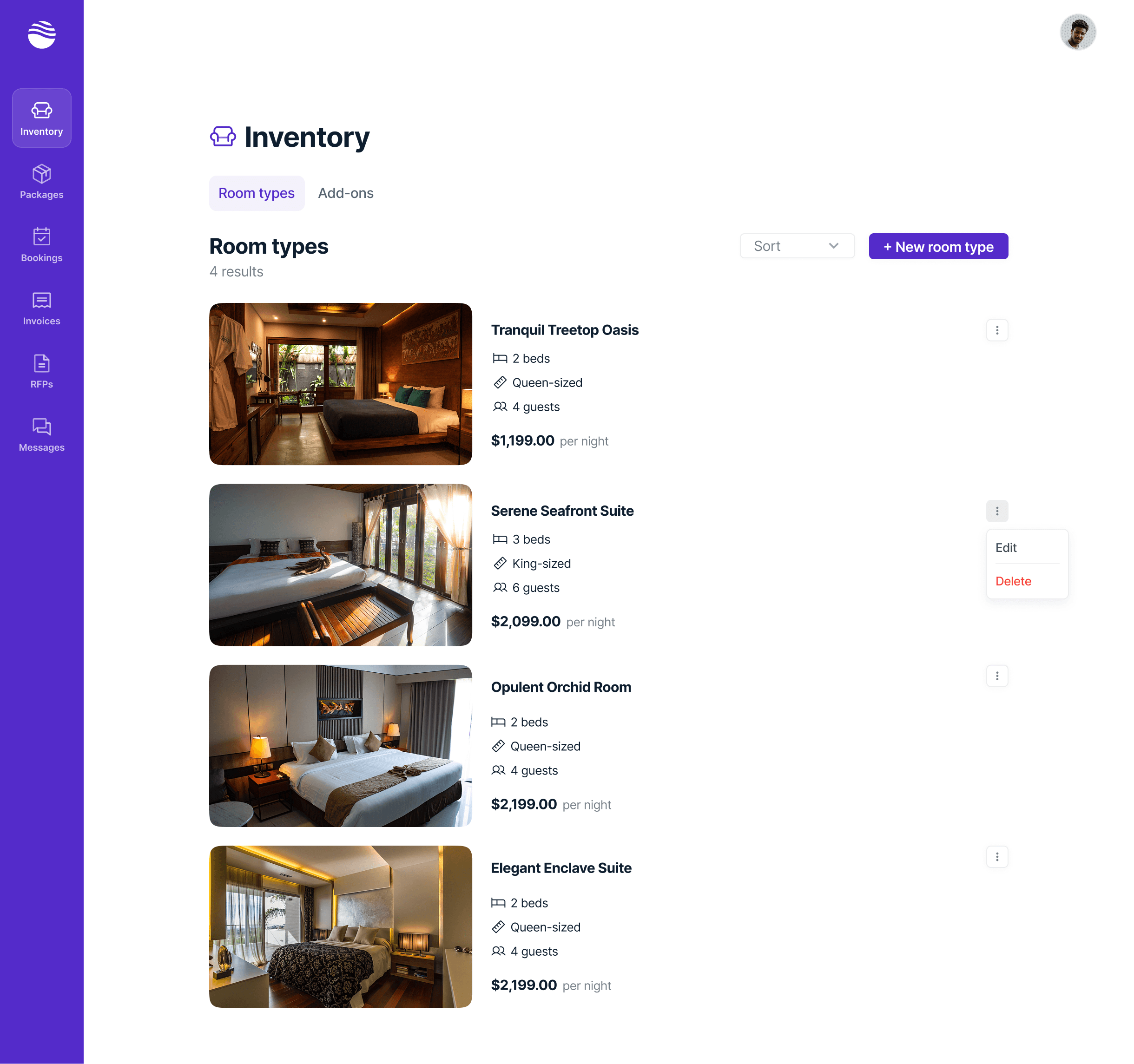
This is the foundation of the entire system. Every downstream experience from package creation to pricing and bookings depends on how well this data is structured.

I designed a highly scannable interface that makes inventory easy to manage, with clear data hierarchy and quick add/edit interactions. The goal was to reduce complexity while ensuring accuracy and consistency.
02

Package Creation

Package Creation

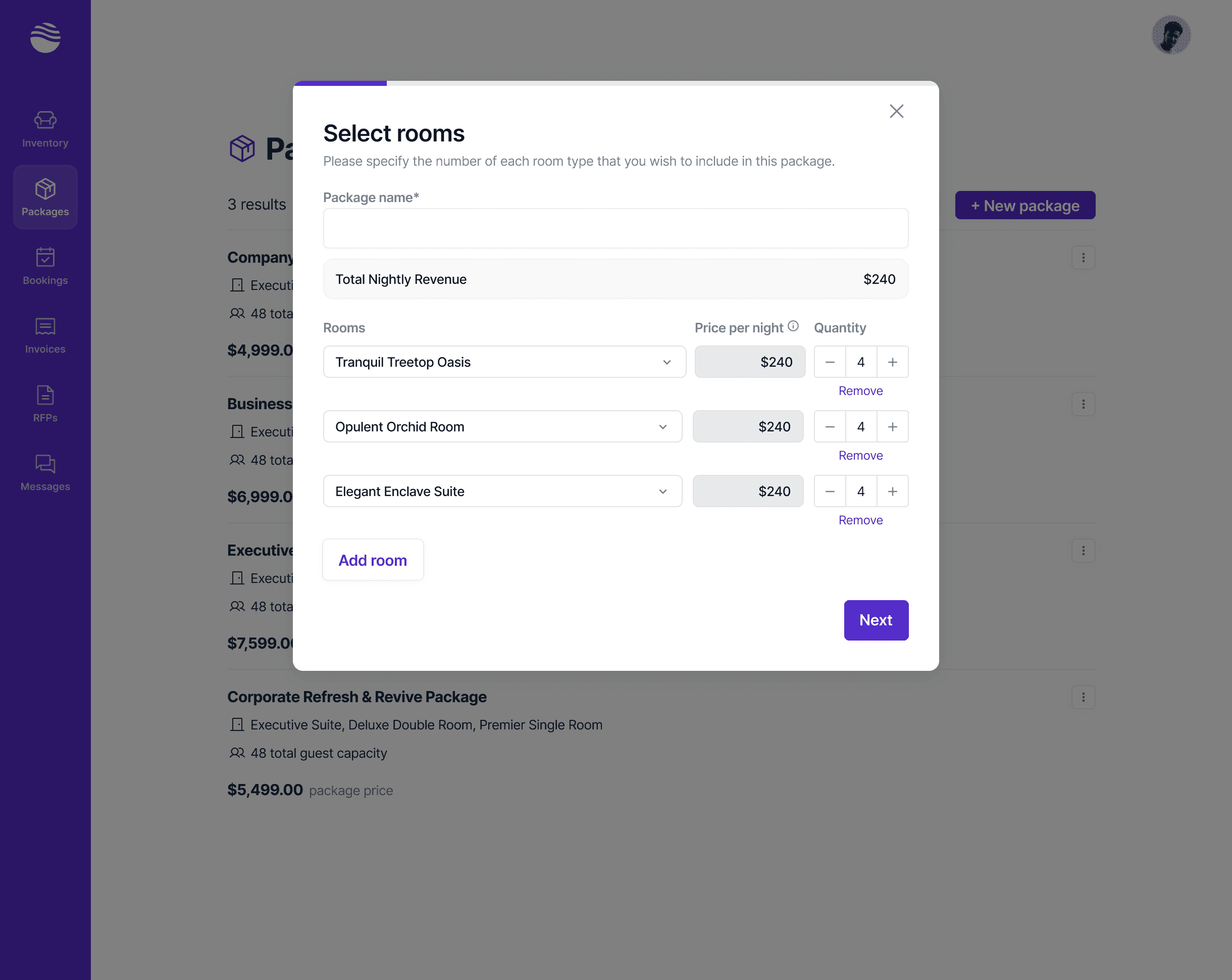
This is the core innovation of the product where supply becomes monetizable. It bridges the gap between raw inventory and a bookable experience.

I introduced a multi-step flow (Rooms → Addons → Pricing) to guide users through complex inputs. Real-time calculations provide clarity on total cost and guest capacity, helping users make confident decisions without feeling overwhelmed.
03

Discovery & Decision

Cards as living objects

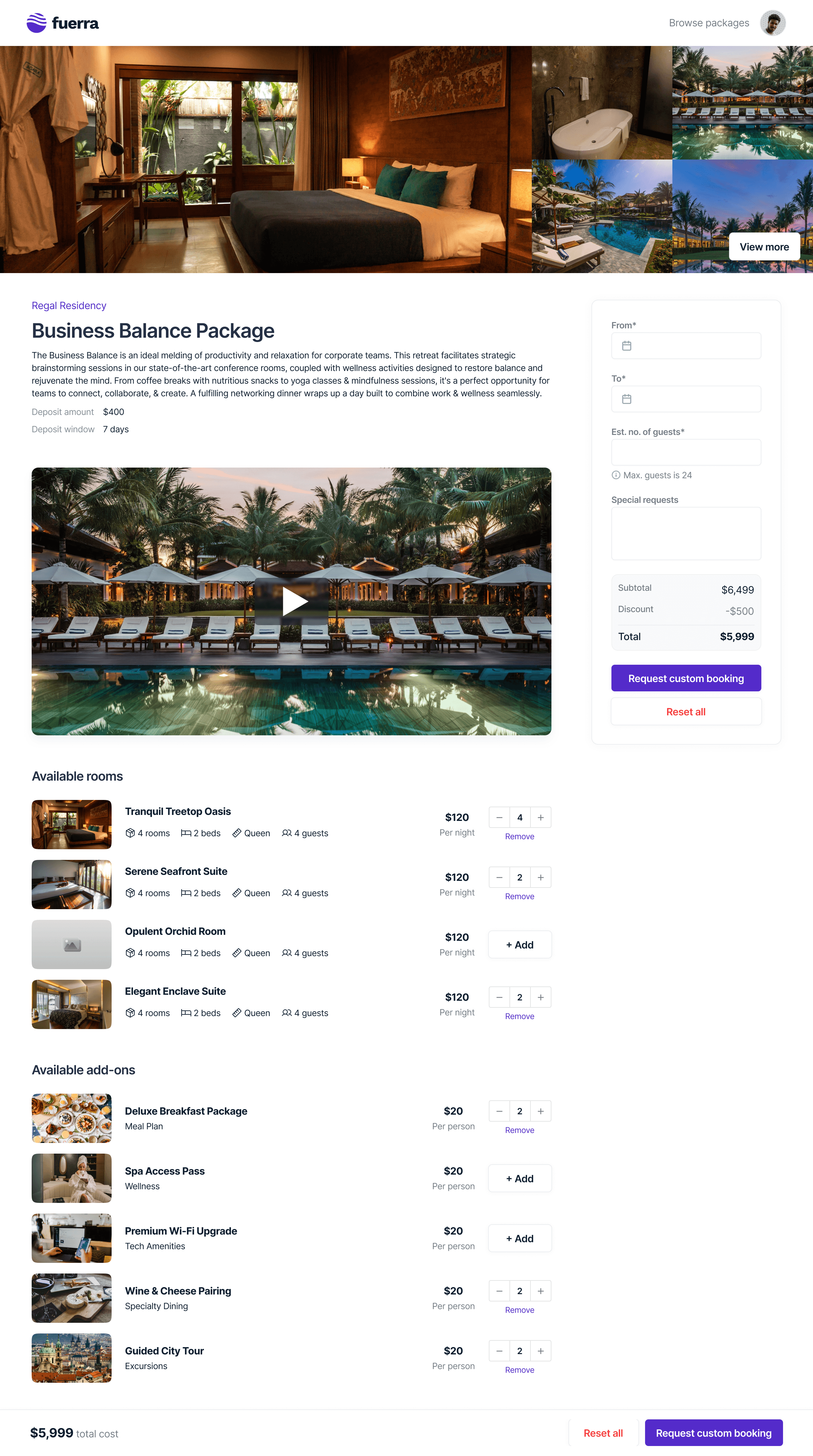
This is the moment where users decide whether to book or not

I prioritised clarity and transparency. Filters enable quick narrowing of options, while the details page clearly communicates pricing, inclusions, and availability. The goal was to reduce uncertainty and build trust at the point of decision.

Key Decisions

Key Decisions

Structuring the Experience into a Single Flow

To eliminate fragmentation and ensure every action feeds into the next.

Standardising Hotel Inventory

Unstructured data would break pricing logic, packaging, and booking flows.

Using Multi-step Workflows

To reduce cognitive load and guide users through complex inputs.

Request-based Booking Model

High-value, customised bookings require validation and flexibility

Linking Retreats to Confirmed Bookings

To ensure data accuracy (pricing, availability, location).

Deposit-based Payment System

To lower commitment barriers for users.

Integrating Messaging into the Platform

To avoid reliance on external tools (email, WhatsApp).

Outcomes & Impact

Outcomes & Impact

27%

27%

Increase in booking conversion rate

Driven by clearer pricing, inclusions, and deposit flexibility

52%

52%

Reduction in manual coordination

Less reliance on emails and external tools

34%

34%

faster time-to-booking

From discovery → confirmed reservation

22%

22%

increase in booking completion (via deposit payments)

Enabled by deposit-based payment model

Lessons

Lessons

The biggest challenge wasn’t designing screens , it was designing a system where multiple users, data, and actions connect seamlessly without breaking the experience.

FULL CASE STUDY ON REQUEST

FULL CASE STUDY ON REQUEST

FULL CASE STUDY ON REQUEST

Smooth Scroll
This will hide itself!